The washing machine is done: a notification from power consumption
Home Assistant watches the washing machine's power in watts and sends you a notification when, after a run, it stays low long enough. You choose the thresholds from the real cycle of your own machine.
- Level
- Beginner
- Active time
- 30–45 minutes
- Home Assistant required
- Yes
Start the washing machine and get on with something else. An hour later you no longer remember it is running, and the wet laundry sits in the drum. Here Home Assistant reminds you with a short message, and you don’t need a washing machine with Wi-Fi.
How it works
While it heats the water, turns the drum or drains, the washing machine draws different amounts of power. After the end it drops to the idle level. Home Assistant first has to detect a run and then wait for the power to stay low.
There is a catch: washing machines make pauses. So you don’t declare the laundry done at every low value. You use a helper switch called helper. It is a memory for the automation (“we saw a run”) and does not turn anything on physically.
The example logic is:
- The power goes above 10 W and stays there 2 minutes: you remember that there is a run.
- Then it drops below 3 W and stays there 10 minutes: you clear the remembered cycle and send one notification.
- Without a newly detected start you don’t send a second message.
These values are a starting point, not universal settings. Two different thresholds keep small fluctuations around one value from counting sometimes as a start and sometimes as an end. The wait helps against short pauses, but a long soak can look like an end.
Power is an indirect sign. Home Assistant does not know for sure whether the program has finished, been cancelled or is paused. The message prompts you to check the washing machine. It does not mean the door is unlocked.
Which meter to choose
You need a sensor for the instantaneous power in W. The accumulated energy in kWh is a different quantity and is no use for these thresholds.
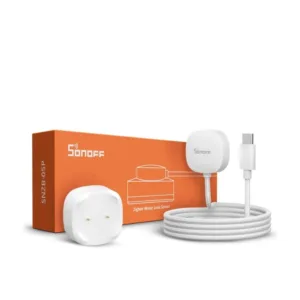
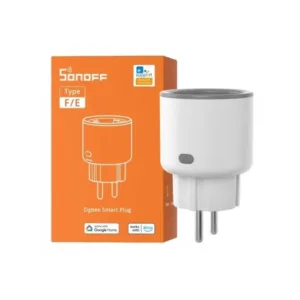
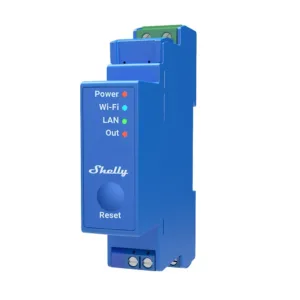
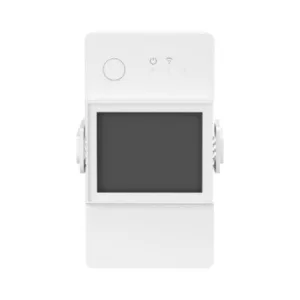
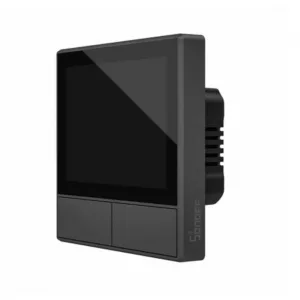
The easiest meter is a smart plug with power measurement, such as the Sonoff S60TPF: you put it between the washing machine and the wall socket, and Home Assistant sees the power in W.
At our place the washing machine and the dryer are on an S60TPF, and as of 19.10.2026 the plug reports power.
If your washing machine also has a cloud integration with a status, you can use that:
- At our place the ConnectLife integration gives the washing machine
running,paused,standby,offandalarm. The statuspausedsolves the long-pause problem that power does not solve.
The rest of this material assumes you already have a power sensor for the washing machine in W.
1. Find the right sensor
In Settings → Devices & services open the metering device and its power. In the entity settings, copy its identifier. In the example it is sensor.washer_power. At our place the same role is played by sensor.washing_machine_power.
Check the unit and the history. The reading should change while the washing machine works and be in W. If the integration reports in kW, the example thresholds do not apply without conversion.
Run your usual program and watch the history. Write down the value before the start, the steady running value, the longest low pause and the reading after the end. The end threshold must be above the after-the-end value, and the wait longer than the longest pause. If there is no clear separation, this approach will not be reliable for your program.
2. Create a memory for the current cycle
From Settings → Devices & services → Helpers → Create helper choose Toggle. Name it “Washing machine: watched cycle” and give it the entity ID input_boolean.washer_cycle_seen. Leave it off.
This switch turns on only after a run has been detected. That way a washing machine that sits idle all day is not a reason for a notification. Documentation: Input boolean.
3. Check the notifications to your phone
In Developer tools → Actions find the action notify.mobile_app_… for your phone and send a short test message. If it doesn’t arrive, check the app’s connection and the notification permission. The automation can’t fix that.
Write down the exact name of the action. It replaces notify.mobile_app_telefon in the second example. Documentation: Companion notifications.
4. Remember the watched run
From Settings → Automations & scenes → Create automation create an empty automation. From the three-dot menu choose Edit in YAML and replace the whole content with the first example. The menu names may be translated according to the interface language.
Replace all occurrences of sensor.washer_power with your sensor. If you chose a different name for the helper, replace that too.
alias: "Washing machine: remember watched cycle"
triggers:
  - trigger: numeric_state
    entity_id: sensor.washer_power
    above: 10
    for: "00:02:00"
    id: active
  - trigger: homeassistant
    event: start
    id: reset
  - trigger: state
    entity_id: sensor.washer_power
    to:
      - "unknown"
      - "unavailable"
    id: reset
conditions: []
actions:
  - choose:
      - conditions:
          - condition: trigger
            id: active
          - condition: numeric_state
            entity_id: sensor.washer_power
            above: 10
        sequence:
          - action: input_boolean.turn_on
            target:
              entity_id: input_boolean.washer_cycle_seen
    default:
      - action: input_boolean.turn_off
        target:
          entity_id: input_boolean.washer_cycle_seen
mode: restart
Besides remembering a run, the automation clears the helper when Home Assistant starts and on unknown or unavailable from the sensor. After an interruption you may miss a cycle, but you won’t take a missing measurement for zero power.
5. Send the notification
Create a second, separate automation in the same way. Paste the second example, replace the sensor, the helper if needed and the action for your phone. If you changed the threshold or the time, fix the text of the message as well.
The two examples are for two separate automations. Don’t put them one after the other in one field and don’t copy them as a whole automations.yaml.
alias: "Washing machine: low power notification"
triggers:
  - trigger: numeric_state
    entity_id: sensor.washer_power
    below: 3
    for: "00:10:00"
conditions:
  - condition: state
    entity_id: input_boolean.washer_cycle_seen
    state: "on"
  - condition: numeric_state
    entity_id: sensor.washer_power
    below: 3
actions:
  - action: input_boolean.turn_off
    target:
      entity_id: input_boolean.washer_cycle_seen
  - action: notify.mobile_app_telefon
    data:
      title: "Washing machine"
      message: >-
        Power has been below 3 W for 10 minutes.
        The program may have finished, check the washing machine.
mode: single
The helper is turned off before sending. That way you don’t get a second message for the same cycle, but if sending fails there is no retry.
If you don’t want to write YAML, there is a community blueprint that keeps the same idea: Notify or do something when an appliance finishes. It checks that the appliance has started and then waits for the power to drop.
Test it
Turn on both automations while the washing machine is idle and the helper is off. Start a new program in the normal way.
| Verification | Expected result |
|---|---|
| The washing machine is idle, the helper is off | No notification |
| The power is above the start threshold for the set time | The helper turns on |
| There is a short pause below the end threshold | No message before the wait ends |
| After the run the power stays low long enough | One notification; the helper turns off |
| The washing machine stays idle after the message | No repeated notifications |
The data becomes unavailable or Home Assistant restarts | The helper is cleared; the cycle may be missed |
See the Traces of the automations and the sensor history. The button Run actions does not check either the threshold or the wait. Plan a Home Assistant restart separately, when it doesn’t interrupt other important automations.
If it doesn’t work
- The notification comes in the middle of the program. Compare its time with the graph. The low pause is probably longer than the wait. Increase the time and try again. With very long pauses, look for a status signal from the washing machine itself.
- There is no notification at all. See whether the helper turned on. If not, the start threshold or the time above it doesn’t match the cycle. If it did turn on, check the end threshold, the trace of the second automation and the test notification.
- After a restart the behavior is different. The wait
foris not kept across a restart or a reload of the automations. A numeric trigger works when the threshold is crossed. Saving an automation in the middle of a program does not guarantee a notification for that cycle. Check with a new full cycle. Documentation: Numeric state. - The number is low but does not update. Some integrations keep the last reading when there is a problem. The example recognizes explicit unavailability, but not a stale number. Check how your integration behaves.
Limitations
The program may have been cancelled or stopped by a person. The power drops in both cases.
The logic runs in Home Assistant. Working without the internet depends on the meter’s integration, and delivery to the phone depends on the notification channel. A local automation does not guarantee push without the internet.
To stop the project, turn off the two automations and the helper. The normal control of the washing machine does not change.
Next project
The washing machine is often also the place of a leak. See how to get a leak notification that repeats until the sensors dry.
Sources and status
The thresholds are examples. The automation that works at our place is for the dryer and uses a blueprint, not this YAML.
At home
MartoSince February 2025
At our place the washing machine and the dryer are each on a Sonoff S60TPF, added through the sonoff integration, which has been in Home Assistant since 19.02.2025. In the program history we looked at on 19.10.2026, the power is between about 3 and 360 W, and between the peaks it drops to a few watts within seconds. There is no notification automation for the washing machine, so the examples in the article follow the documentation. The dryer automation "Dryer controls closet exhaust fan" is on and uses a blueprint: it starts the fan in the wardrobe room when the power goes above 10 W and stops it after the end; it last fired on 19.10.2026.
Need a hand?
We can set up and install everything in this project. In some regions we install it ourselves — ask us.
Contact us